
Every traveler knows the feeling. You’re standing over an open suitcase two hours before you leave, cramming in “just one more” pair of shoes, and the zip still won’t close. You hit the airline’s weight limit before you’ve even added your toiletries. And somewhere in the back of your mind, you already know you’ll wear about half of what’s in there.
Packing efficiently isn’t a gift some people are born with. It’s a system — and once you learn it, traveling gets noticeably lighter, cheaper, and less stressful. Whether you’re heading out for a long weekend or three weeks abroad, the principles are the same.
Why a Packing List Changes Everything
The single biggest cause of overpacked bags isn’t greed — it’s panic. When you pack in the last hour before a trip, your brain defaults to “what if” thinking. What if it rains? What if there’s a fancy dinner? What if I want a third outfit option on day five? That thinking fills your bag with things you’ll never touch.
Start your packing list at least three days before you leave. Check the actual forecast for your destination — not just the season, but the specific week you’ll be there. There’s no reason to bring heavy sweaters for a trip where the lowest temperature is 18°C.
Before you write anything down, check what your accommodation already provides. Most hotels and many holiday apartments supply towels, beach towels, and a hairdryer. Leaving those at home opens up a surprising amount of space immediately.
Once your list is written, cut it. The 90 percent rule works well here: write down everything you think you want to bring, then deliberately cross off the bottom ten percent — the items you added last and feel least certain about. They’re almost always the right ones to leave behind.
One thing most people overlook: nearly everything you forget can be bought or borrowed at your destination. A pack of razors, a bottle of shampoo, an umbrella — these are not worth dragging across borders.
Build a Travel Capsule Wardrobe Before You Pack a Single Item
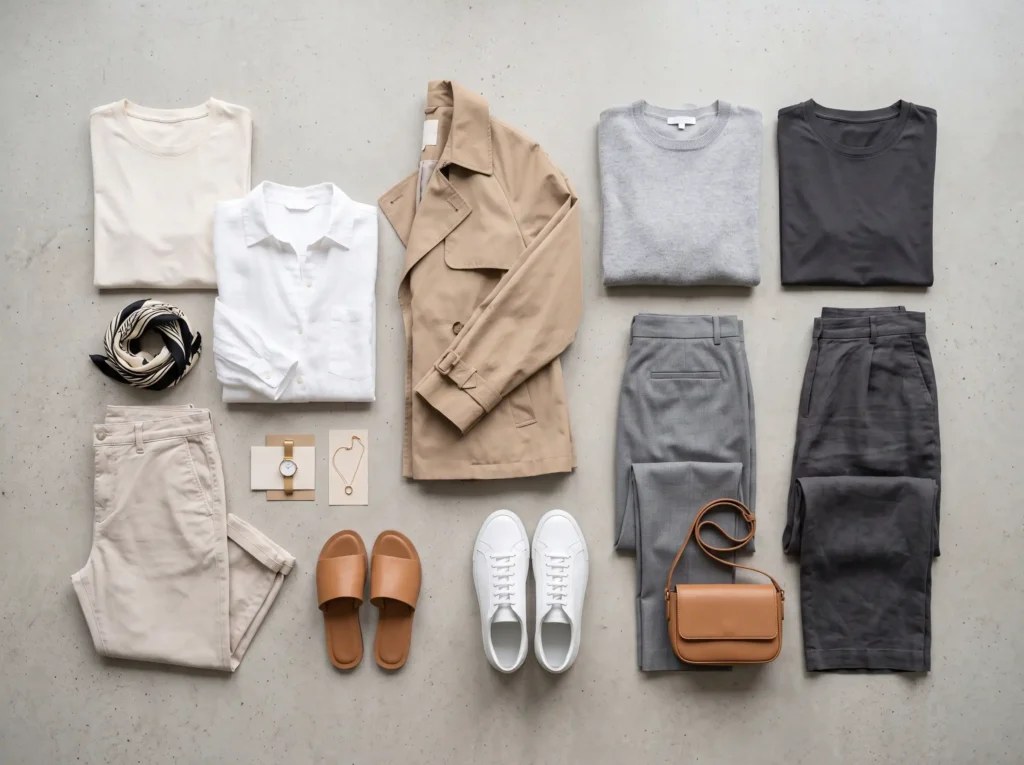
The most effective way to cut clothing volume while still having real outfit options is to build a Travel Capsule Wardrobe before you even open the suitcase. The concept is simple: a small collection of pieces that all work together, so every combination you pack is a usable outfit.
Start With a Neutral Color Base
Pick two or three neutral base colors — black, white, navy, grey, or beige — and stick to them. Add one accent color if you want personality. When everything shares a palette, you eliminate the problem of bringing a top that only works with one specific bottom, which is one of the fastest ways bags fill up.
In practice, this also means you stop packing “statement” pieces that only go with one thing. Every item needs to earn its place by working with at least two others.
The 3-3-3 Rule for Short Trips
For trips between three and seven days, the 3-3-3 Rule is a reliable framework: three tops, three bottoms, three pairs of shoes. Nine pieces that theoretically create up to 27 different combinations. For longer trips, scale it proportionally — but keep the combinability principle intact. More pieces only make sense if they genuinely add new outfit options, not just variety for its own sake.
Fabric Matters More Than You’d Expect
The right materials make packing significantly easier. Merino wool is the standout choice for travel — it’s breathable, temperature-regulating, naturally odor-resistant, and genuinely holds up to being worn two or three times before needing a wash. That last point matters more than it sounds on longer trips, because it directly reduces how much you need to pack.
Tencel, jersey, and travel-specific synthetic blends are excellent for wrinkle resistance. Linen looks great but wrinkles heavily in a bag — factor that in before you pack it. Heavy denim is worth leaving behind on most trips; it takes up space, weighs a lot, and takes forever to dry if it gets wet.
A Practical Week-Long Packing List
Here’s what actually fits in a standard carry-on trolley for a seven-day trip:
- Tops: 4–6 pieces — two plain t-shirts, one smarter shirt or blouse, one lightweight long-sleeve, one tank top
- Bottoms: 2–3 pieces — one versatile travel trouser, one pair of jeans, one shorts or skirt
- One-piece: A dress or jumpsuit — takes minimal space and creates a complete outfit instantly
- Layers: 1–2 pieces — a light cardigan or thin pullover, and optionally a packable jacket
- Shoes: Maximum 2–3 pairs — comfortable sneakers for travel days and walking, one smarter pair for evenings, and sandals or slippers only if the trip genuinely calls for them
How You Pack Matters as Much as What You Pack
Once you’ve chosen your items, the physical packing makes or breaks your available space — and the condition your clothes arrive in.
Rolling Clothes: Still the Best Default
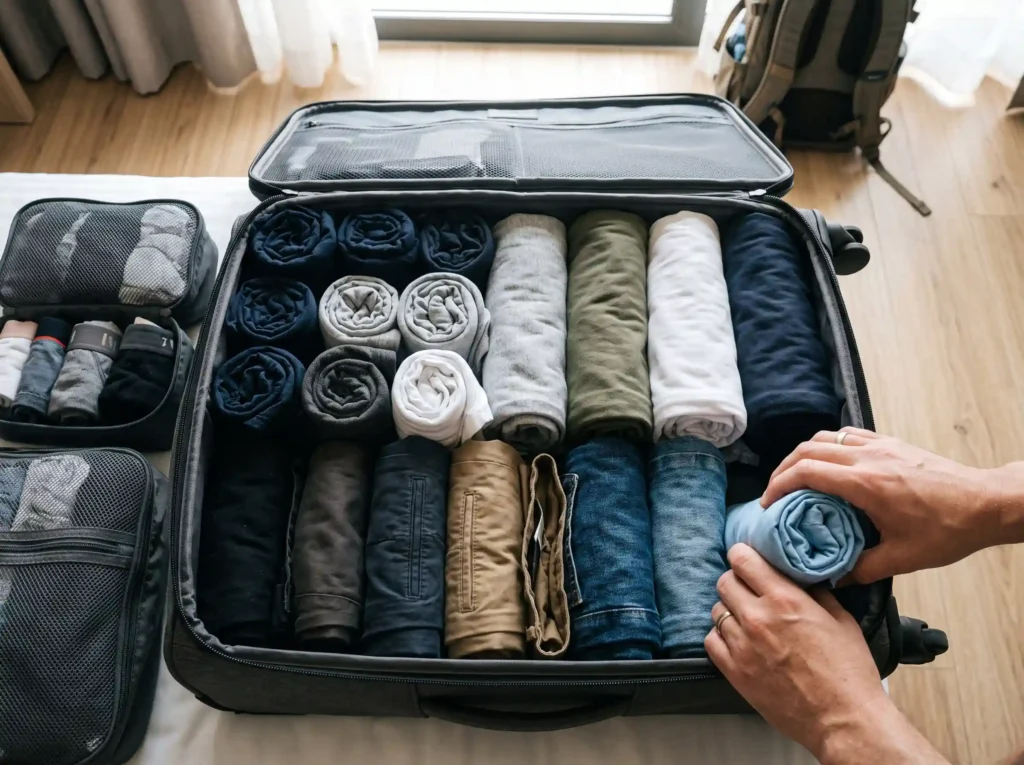
Rolling instead of folding remains one of the most effective packing techniques available. Rolling compresses fabric and can save up to 30 percent more space than flat folding. It also reduces sharp creases, because the fabric bends gradually around a curve rather than snapping at a fold line.
It works best on elastic fabrics: t-shirts, underwear, activewear, leggings, and lightweight trousers. Stiffer fabrics like dress shirts and structured blazers do better folded flat — rolling them creates awkward bumps at the collar and shoulders.
The Marie Kondo Method for Folded Items
If you prefer folding, the Marie Kondo filing method solves the biggest problem with traditional stacking: you have to unpack the whole bag to find something at the bottom. With this technique, clothes are folded into compact rectangles that stand upright on their own, then placed side by side in the bag like files in a drawer. You can see every item the moment you open the suitcase. Nothing gets buried.
Outfit Bundling for Frequent Movers
If you’re on a trip where you change locations nearly every day — a multi-city itinerary or a backpacking route — outfit bundling (sometimes called Ranger Rolling) is worth knowing. You roll a complete day’s outfit together: a t-shirt, underwear, and socks in one tight bundle. At each new stop, you grab one bundle and you’re done. No rummaging through a disorganized bag at 6am trying to find matching socks.
Pack the Suitcase Like a Three-Dimensional Puzzle
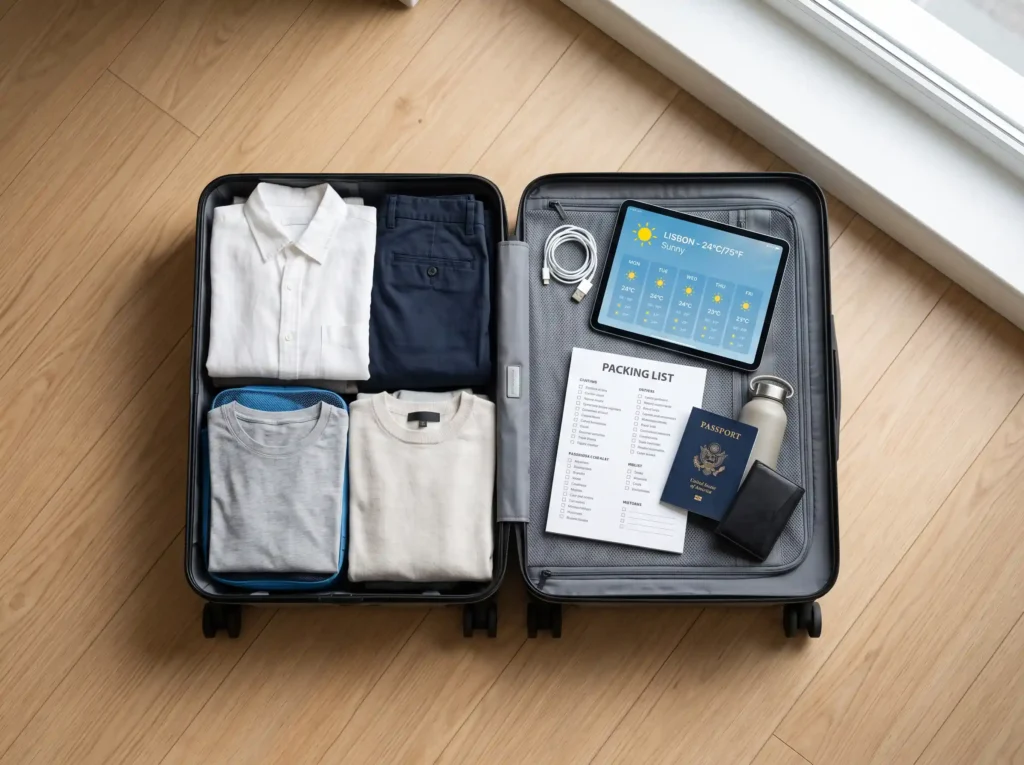
A well-packed bag isn’t random. It’s a structure — and treating it that way gets noticeably more in without making it feel stuffed.
Use Packing Cubes — They’re Worth It
Packing cubes have genuinely changed how experienced travelers pack. These lightweight zippered pouches act as removable drawers inside your bag. You sort by category (tops in one, underwear in another, bottoms in a third) and the whole system becomes instantly accessible at your destination — you can move an entire cube into a hotel drawer in seconds.
Compression packing cubes go further: a second zip compresses the cube down, squeezing out excess air and reducing the volume of your clothes again. The result is a suitcase that looks organized even after a week on the road.
Weight Distribution: Heavy Items at the Bottom
Always pack heavy items near the wheels. Shoes, toiletry bags, books, jeans, and heavy chargers all go at the base of the bag. When the suitcase stands upright, that weight sits at the bottom without crushing lighter items on top. It also makes the bag more stable when you’re wheeling it — a top-heavy suitcase tips over constantly.
Fill Every Gap
Hollow spaces in a packed bag are wasted volume. Stuff socks, underwear, and rolled belts inside your shoes. This serves two purposes: it fills dead space, and it keeps your shoes from collapsing and losing their shape in transit. Belts can also be unrolled and placed flat along the inside edge of the bag, or rolled into shirt collars to keep them from creasing. Small gaps between packing cubes are ideal for charging cables, adapters, and anything else that’s flexible enough to fill an odd shape.
Navigating Liquids and Carry-On Rules Without the Stress
Carry-on liquid restrictions catch more travelers off guard than almost anything else at the airport. Getting this wrong costs time, money, and sometimes an item you can’t replace.
The 100ml Rule: What It Actually Means
Any liquid, gel, paste, or cream in your carry-on must be in a container with a labeled capacity of 100ml or less. The key word is labeled capacity — not how full it is. A half-empty 150ml tube of toothpaste will be confiscated, because the container says 150ml on the side. All qualifying containers must fit inside a single, transparent, resealable plastic bag with a maximum capacity of one liter. One bag per passenger.
What Counts as a Liquid — The List That Surprises People
The definition of “liquid” at security is broader than most travelers expect. Beyond drinks and perfumes, it includes toothpaste, hair gel, aerosol deodorant, mascara, lip gloss, shaving foam, and even spreadable foods — honey, jam, Nutella, cream cheese. If you’re unsure, pack it in your checked bag or leave it at home.
CT Scanners: Not a Universal Solution Yet
Some airports now use CT scanners that allow liquids and laptops to stay in your bag during screening, and in some cases apply looser limits. The reality is these scanners aren’t everywhere yet, and they vary by airport and even by checkpoint. If your itinerary includes a connection, your layover airport may not have them. Stick to the 100ml rule and you’ll never be caught out mid-journey.
Solid Toiletries: The Cleanest Solution
The simplest way to bypass liquid restrictions entirely is to switch to solid toiletries. Solid shampoo bars, conditioner bars, solid soap, solid deodorant, and toothpaste tablets aren’t classified as liquids, so they go straight into your toiletry bag without occupying any space in your one-liter pouch. They also tend to last longer than their liquid versions and create less plastic waste. For water on the go, bring an empty reusable bottle through security and fill it at a drinking fountain airside — free, and you avoid paying airport prices.
The Packing Mistakes That Cost Travelers the Most
Even people who travel regularly fall into the same traps. These five mistakes are the most common — and the most avoidable:
- Packing for hypothetical scenarios. If you’re genuinely unsure whether you’ll wear something, leave it. Almost anything can be washed or bought cheaply at your destination. The cost of carrying it everywhere is always higher than the cost of replacing it.
- Relying on vacuum bags for clothes. Vacuum compression bags work well for bulky items like down jackets and blankets. For regular clothing, they compress volume but don’t reduce weight — and they often push you over the airline’s weight limit. Clothes also wrinkle badly in vacuum bags, and at the destination, you rarely have a vacuum cleaner to reseal them. Packing cubes do the same job without the downsides.
- Burying important items. Your passport, wallet, boarding passes, medication, and power bank should never be deep in a packed bag. Keep them in an external pocket or a small personal bag that stays with you throughout the flight.
- Not checking your airline’s specific rules. Carry-on dimensions and weight limits vary significantly between airlines — budget carriers in particular have tightened restrictions and actively enforce them at the gate. Measure and weigh your bag at home before you leave. A gate fee for an oversized carry-on is always more expensive than checking it in advance.
- Packing your heaviest items instead of wearing them. Your thickest jacket, heaviest boots, and bulkiest sweater should be on your body on travel day — not inside the bag. Once you’re seated on the plane or train, you can take the jacket off and put it in the overhead bin. This one habit alone can free up a significant portion of your bag’s weight allowance.
The Real Payoff of Packing Light
A well-packed bag changes more than just the weight on your shoulder. It changes how a trip starts. You move faster through airports, skip the baggage carousel entirely, and never stand at a lost luggage desk wondering where your things ended up. You have money left over that didn’t go to overweight fees. And you can walk into a new city the moment you land, without dragging an overloaded case to your hotel first.
Packing is a skill. The first time you try a capsule wardrobe or commit to carry-on only, it feels uncomfortable. By the third trip, it feels obvious. The gap between “I might need this” and “I actually need this” is where most unnecessary weight lives — and closing that gap is worth the effort every single time.
Quick Comparison of Packing Techniques
| Technique | Best Used For | Space-Saving Potential | Primary Benefit |
|---|---|---|---|
| Rolling | Elastic fabrics (t-shirts, activewear, underwear) | High (up to 30% space saved) | Compresses fabric and reduces sharp creases |
| Marie Kondo Method | Folded items and structured clothes | Medium | Allows vertical storage so everything is visible at once |
| Outfit Bundling (Ranger Rolling) | Frequent movers, backpackers, and multi-city trips | High | Creates pre-matched, grab-and-go daily clothing packs |
| Packing Cubes | Categorized organization and volume reduction | High (with compression cubes) | Acts as drawers to keep your suitcase organized in transit |
Frequently Asked Questions
How does the 3-3-3 packing rule work?
The 3-3-3 rule is a packing framework for short trips (3 to 7 days) where you select three tops, three bottoms, and three pairs of shoes. These nine versatile pieces can be combined to create up to 27 different outfit options.
Is it better to roll or fold clothes when packing?
Rolling is generally better as it compresses fabric to save up to 30 percent more space and prevents deep creases. However, folding is preferred for stiffer items like dress shirts and blazers, which can become awkwardly misshapen when rolled.
What is the 100ml liquid limit for carry-on luggage?
The 100ml rule requires all liquids, gels, pastes, and creams in carry-on bags to be in containers of 100ml or less by labeled capacity. These containers must fit inside a single, transparent, one-liter resealable bag.
How do you pack a suitcase to distribute weight correctly?
Pack your heaviest items—such as shoes, toiletries, books, and chargers—at the bottom of the suitcase near the wheels. This keeps the suitcase stable when rolled and prevents heavy items from crushing delicate clothes.
What toiletries do not count as liquids for airport security?
Solid toiletries do not count under liquid restrictions. You can pack solid shampoo and conditioner bars, bar soaps, solid deodorants, and toothpaste tablets directly in your toiletry bag without using your one-liter liquids pouch.
