
Seeing a lion pull down a wildebeest at the Mara River crossing. A Bengal tiger stepping out of the morning haze at Ranthambore. A jaguar moving low along a riverbank in the Pantanal, close enough that you hold your breath. These are the moments that ruin ordinary travel permanently. Nothing else quite competes.
Deciding where to go for a wildlife safari is not a simple question. Every continent offers something genuinely different — different animals, different landscapes, different rhythms of movement. The right destination comes down to what you’re chasing, when you can travel, and what kind of experience you want. Choosing well doesn’t just guarantee a better trip; it also determines whether your money supports the conservation work that keeps these places alive.
The economics here are worth understanding. The African safari industry is projected to grow from approximately $19.18 billion in 2024 to around $31.75 billion by 2032, according to ecotourism market analysts. Before the global pandemic disrupted travel, nature tourism accounted for 8% of Kenya’s GDP, 10.6% of Tanzania’s, and a remarkable 11.5% of Botswana’s. That is not a footnote — it is the reason these governments have a concrete incentive to protect wildlife instead of converting land for agriculture or industry. Poaching tells the flip side of the same story. When iconic species disappear, tourism revenue collapses. Estimates put those losses at up to $25 million annually from elephant population decline alone. The animal you came to see funds the ranger who protects it. That chain matters.
Africa: The Heart of World-Class Wildlife Safari
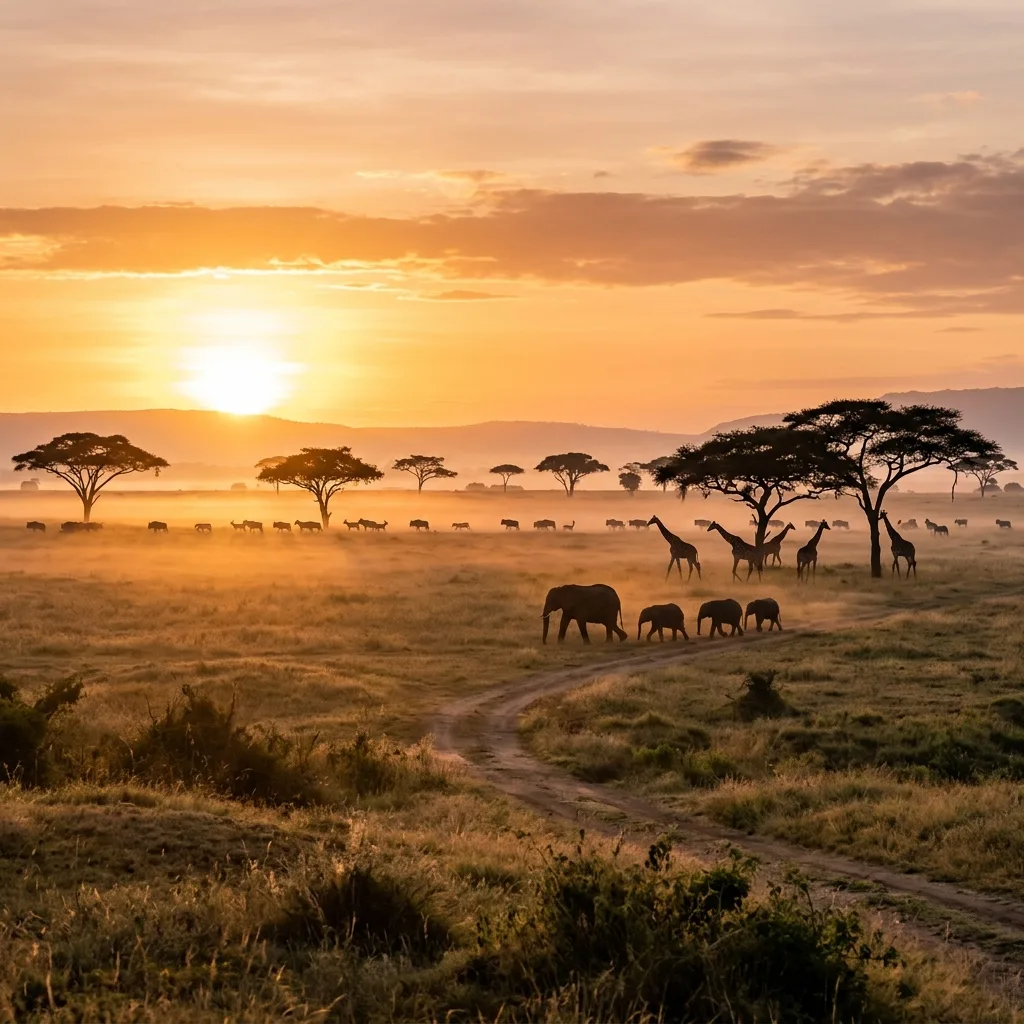
Africa remains the first answer most people give when you ask about wildlife safari — and for good reason. Open savanna, extraordinary animal density, a safari industry more than a century old: no other continent has stacked the deck quite the same way. It is the most accessible entry point for first-time wildlife travelers and the benchmark every other destination gets measured against.
Serengeti and Masai Mara: Where the Great Migration Plays Out All Year
The Serengeti and the Masai Mara are, ecologically, the same system. A political border between Tanzania and Kenya splits the landscape, but the animals don’t follow it. What they do follow — every single year, without exception — is the grass.
More than a million wildebeest, alongside hundreds of thousands of zebras and gazelles, move in a continuous, year-round circuit in search of fresh pasture. This is the Great Migration, the largest overland wildlife movement on the planet, and it is never concentrated in one place at one time. The migration follows a rough clockwise rotation: the southern Serengeti during calving season from January through March, northward through the central plains, and eventually into the Masai Mara between July and October for the river crossings.
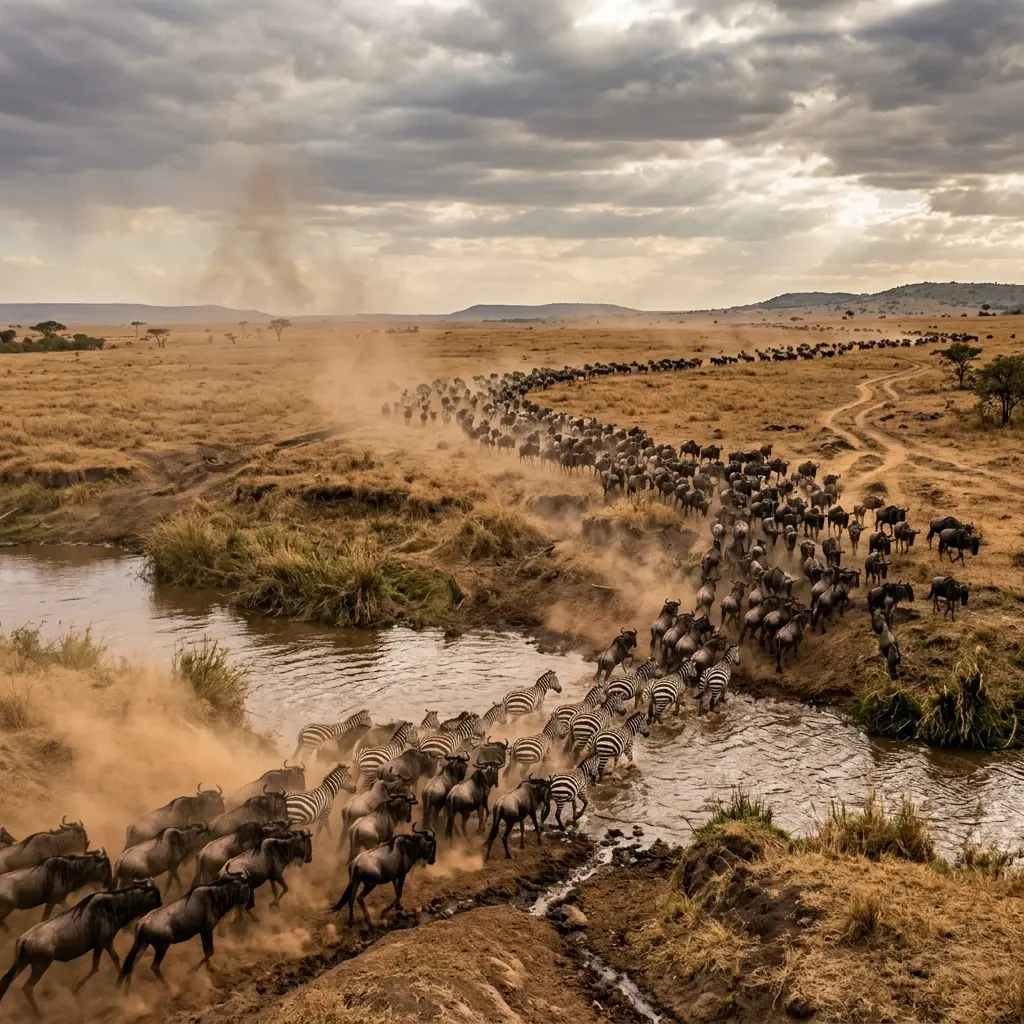
Those crossings are what most people come for. At the Mara River, wildebeest gather by the thousands on the bank — hesitating, retreating, surging forward — before plunging into water full of Nile crocodiles. The chaos is extraordinary. The Masai Mara’s compact geography means you can cover a lot of it quickly, which makes it ideal if your time is limited. The Serengeti, whose name comes from the Maasai word Siringet — meaning “land without end” — rewards those who stay longer. The calving season draws lions, cheetahs, and hyenas in extraordinary concentrations. Thousands of wildebeest calves are born within weeks of each other, and the predators know it.
One thing most visitors overlook: the Great Migration is never in one dramatic location. At any given moment, it is spread across hundreds of kilometers. A knowledgeable guide who knows exactly where the herds are that week is worth more than any amount of pre-trip research.
Kruger National Park: South Africa’s Big Five Stronghold
Kruger is one of the largest national parks in Africa and one of the most visitor-friendly on Earth. A well-maintained road network means you can self-drive through the park in a standard rental car — something very few African parks allow. For families, independent travelers, or anyone who values flexibility without a fixed schedule, that accessibility matters.
The park holds healthy populations of all five of the Big Five — lion, leopard, elephant, Cape buffalo, and rhinoceros — along with wild dogs, cheetahs, hippos, and hundreds of bird species. Getting around on your own is genuinely enjoyable. But here is where most first-timers make a mistake: they spend all their time inside the national park and miss what the private reserves next door offer.
Adjoining concessions like Sabi Sands and MalaMala share an unfenced border with Kruger, meaning the same animals move freely between public and private land. The difference is what happens inside those private reserves. Guides can take vehicles off established roads to track a leopard into the bush. Night drives are permitted, which is when predators are most active. Walking safaris with armed guides are an option. And vehicle numbers around any sighting are strictly limited, so you are never fighting twelve other jeeps for a sightline. The premium price is real. So is the difference in experience.
Okavango Delta and Chobe: Where Botswana’s Safari Happens on Water
Botswana has made a deliberate choice: high cost, low volume, maximum conservation impact. Visitor numbers are capped, camps are small, and the fees reflect that model. The result is one of the most genuinely unspoiled safari environments left in Africa.
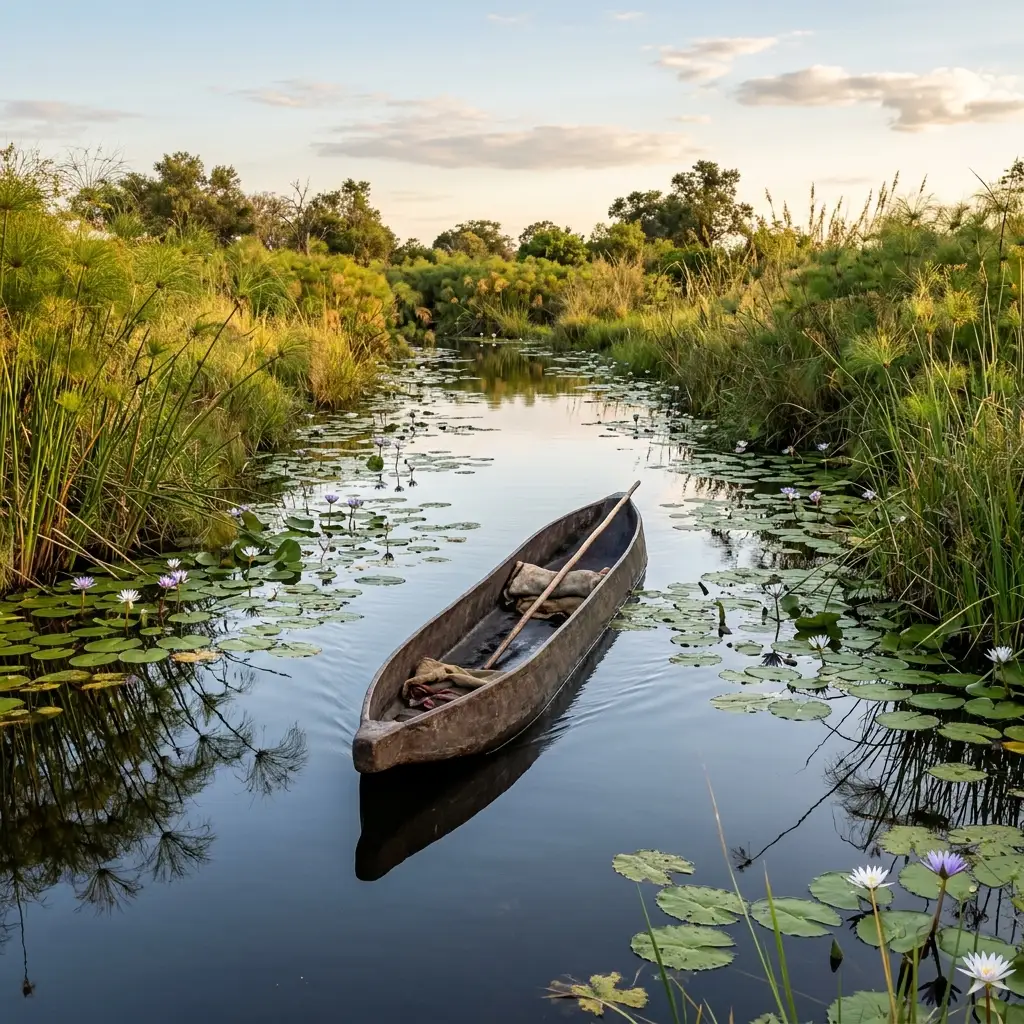
The Okavango Delta exists because of a geographical accident. The Okavango River flows inland from Angola but never reaches the ocean. Instead, it fans out and disappears into the Kalahari Desert, creating a seasonal labyrinth of channels, floodplains, and islands that shifts every year. Safaris here are done from mokoros — traditional flat-bottomed canoes, poled silently through papyrus reeds by guides who know every channel by memory. The silence is the point. No engine noise, no dust, no other vehicles. Just water, birds, and the occasional hippo surfacing nearby.
The delta is home to sitatunga and lechwe — antelope species adapted specifically to wetland life — along with elephants that swim between islands, massive crocodiles, and a birdlife so varied that serious birders plan entire expeditions around it alone.
About 250 kilometers northeast, Chobe National Park offers something completely different: the highest concentration of elephants in Africa. The best way to experience it is by boat, not jeep. An afternoon on the Chobe River, watching hundreds of elephants wade in to drink, swim, and spray each other, is one of the most remarkable wildlife spectacles the continent offers — and it plays out at almost arm’s length from the boat.
Asia: Tracking Tigers and Leopards Through Ancient Landscapes
Asian wildlife travel requires a different mindset than African safari. The vegetation is denser, the animals are harder to find, and the payoff when you do find them hits differently when you know how much patience it cost. If Africa is safari on an open stage, Asia is safari in a mystery novel.
Ranthambore National Park: India’s Best Chance at a Wild Tiger Sighting
Ranthambore sits in Rajasthan, a state better known for its palaces and desert architecture — and the park itself feels like an extension of that history. Ancient temples disappear into the undergrowth. A 10th-century fort dominates the ridge above the park. Somewhere in the dry teak forest below, Bengal tigers move through ruins built long before anyone thought to conserve them.
Safaris operate in open-sided Gypsy jeeps and larger Canter vehicles, moving through strictly controlled zones assigned by the Indian government to prevent crowding around sightings. The system is not perfect — popular zones can still fill up — but it does spread vehicle traffic more evenly than parks where access is unregulated.
The best months to visit run from October through June. Summer months — April through June — are punishing in terms of heat. They are also the most productive for tiger sightings. By late spring, water sources across the park have mostly dried up. The tigers have no choice but to come to the few remaining pools in the open, sometimes staying for hours at a time. It is the clearest demonstration of how understanding animal behavior, not just showing up, is what separates a memorable safari from a frustrating one.
One practical note most travel guides skip: Ranthambore’s zones vary significantly in tiger density. Zones 3, 4, and 5 are widely considered the most productive. Booking safari permits specifically in these zones, rather than accepting whatever you are assigned by default, makes a measurable difference in your chances.
Yala National Park: Sri Lanka’s Leopard Capital
Sri Lanka does not get the same attention as its larger neighbors in the wildlife travel world, and that is its greatest asset. The island is ecologically extraordinary: dense rainforest in the interior, dry scrubland in the southeast, coastal lagoons and beaches where terrestrial and marine wildlife blur together. Yala sits in that southeastern corner and holds one of the highest leopard densities of any protected area in the world.
Leopards are famously secretive animals. In most of Africa, spotting one requires significant patience and a skilled tracker. At Yala, the density is high enough that sightings happen with reasonable regularity during the dry season, from February through July. The park also holds large herds of Asian elephants, sloth bears, axis deer, crocodiles, and a birdlife that includes dozens of endemic species.
The main caveat: Yala’s most productive zone can become uncomfortably crowded during peak dry season weekends, with too many vehicles converging on the same leopard sighting. If that kind of experience defeats the purpose for you, two options worth knowing: visit on weekdays, or redirect to Wilpattu National Park in the northwest. Wilpattu offers comparable leopard habitat with virtually none of the crowds — consistently underrated by international travelers and consistently preferred by serious wildlife photographers.
South America: Giant Wetlands, Island Evolution, and Jaguars
South America’s wildlife offer is completely different from Africa’s or Asia’s — not lesser, just different. The Pantanal and the Galápagos Islands are among the most specialized wildlife experiences on the planet, and neither of them resembles anything else on this list.
The Pantanal: The World’s Best Place to See a Wild Jaguar
Most travelers think “Amazon” when they think of South American wildlife. The Pantanal is actually the better option for seeing large animals — and the reasons are straightforward. The world’s largest tropical wetland, spanning primarily western Brazil, works differently from the rainforest. Its vegetation is more open, the waterways are navigable, and the animals have nowhere to disappear into a continuous canopy. That visibility is everything.
Jaguar safaris run primarily by speedboat along the rivers of the Porto Jofre region during the dry season, from June through October. In these months, the water levels drop, animals concentrate along the river margins, and jaguars patrol the banks hunting caimans and capybaras in the open. Sightings are not guaranteed — nothing in wildlife is — but the Pantanal offers better odds for jaguar than anywhere else on Earth. Not slightly better. Dramatically better.
The supporting cast is equally impressive. Giant river otters — among the rarest carnivores in South America — are reliably seen here. Giant anteaters walk the savanna grasslands at the wetland’s edges. Brazilian tapirs, the largest land mammals in South America, come to the water’s edge at dusk. And the hyacinth macaw, the world’s largest parrot, nests in the palm stands throughout the region. It is an ecosystem where every hour on the water produces something unexpected.
The Galápagos Islands: Wildlife That Has Never Learned to Fear Humans
The Galápagos works by rules that apply nowhere else. The islands sit in the Pacific, 1,000 kilometers west of the Ecuadorian mainland. That isolation has lasted long enough for evolution to run its own independent course — producing species found nowhere else on Earth. But the feature that makes Galápagos unlike any other wildlife destination is behavioral, not just biological.
The animals simply do not treat humans as a threat. There are no large land predators on the islands. Over millions of years of evolution, there was no pressure to develop the wariness that wildlife everywhere else learns. The result: Galápagos giant tortoises lumber past your feet without acknowledgment. Marine iguanas — the only ocean-swimming lizards on the planet — bask in piles on the rocks around you. Sea lions sleep on park benches. Blue-footed boobies perform their mating dances at eye level. You walk carefully here, because otherwise you might step on something.
Safaris here take two forms: expedition cruises, which move between islands overnight and let you experience multiple ecosystems across a week or more, and day trips from the inhabited islands of Santa Cruz or San Cristóbal. Cruises are more immersive and the better choice for serious wildlife observation. Activities combine guided walks on volcanic lava trails with snorkeling in waters shared by sea turtles, rays, and reef sharks. This is the one destination on this list that cannot be compared to anything else. It is its own category entirely.
Safari Ethics: How Responsible Travel Protects the Wildlife You Came to See
There is a tension built into wildlife tourism that does not always get discussed openly. The money generated by safari travel funds the rangers, the anti-poaching units, and the community programs that keep these ecosystems intact. At the same time, that tourism can damage the very places it depends on — through vehicle crowding, habitat disturbance, and revenue that often flows upward to international operators rather than staying with local communities.
The damage is real. Too many vehicles around a cheetah during a hunt will disrupt the kill attempt. The animals abandon it, burn energy they cannot afford to waste, and gradually shift their movements away from roads and viewing areas. Similar patterns affect lion pride dynamics, breeding behavior, and den site selection. The animals do not file complaints. They just change what they do, and sightings become less frequent — which hurts the tourism economics that justified the conservation in the first place.
Traveling responsibly on safari means doing four specific things:
- Choose operators who actually employ local people: Look for companies that hire local guides at fair wages, partner with nearby communities, and direct revenue toward specific conservation or development projects. Vague sustainability language on a website is not evidence of any of this. Ask directly: how many of your guides are from the area, and what community projects do you fund?
- Do not push your guide for closer access: Every park has rules about minimum approach distances and off-road restrictions. Those rules exist for the animals, not for tourists. A guide who breaks them on request is not providing better service — they are creating risk for the wildlife and for their own license. Decline the invitation to press closer.
- Reduce your plastic footprint: Many remote safari camps already operate on solar power and use advanced water recycling systems. Pack accordingly — reusable water bottles, minimal single-use packaging. Waste management in remote ecosystems is genuinely expensive and logistically difficult. Don’t add to the problem.
- Keep wildlife wild: Never feed animals, regardless of how tempting the situation feels. Habituation to food changes behavior permanently. An animal that associates humans with food becomes a conflict animal — one that enters camps, raids villages, and ultimately gets killed. Every seemingly harmless feeding moment carries that downstream risk.
A live lion photographed by a thousand tourists generates more revenue over its lifetime than a single trophy hunt. A live elephant herd sustains a camp, funds employment, and draws visitors for decades. The case for conservation is not just ethical — it is financially obvious. The more that argument holds up in practice, the better the odds that these animals are still here for the next generation to find.
Sources
- Travels & Beer: Travel Guides and Tips
- PANGEA The Travel Store: Custom Travel Experiences
- Hanaley Travel: Luxury Safaris and Destinations
- Altezza Travel: Tanzania Safaris and Kilimanjaro Climbs
- Trails and Oceans: Ecotourism and Adventure Destinations
- Passport Marks: Safari Travel Journals and World Wildlife
- TourRadar: Organized Tours and Safari Circuits
- Ecotourism World: Sustainable Tourism News and Data
- Future Market Insights: Ecotourism Market Research
- Spherical Insights: Global Safari Market Analysis
- Persistence Market Research: Adventure Ecotourism Trends
- Born Free Foundation: Economic Impact of Elephant Conservation
- El País: Sustainable Tourism Challenges in Africa
- Go2Africa: African Safari Specialists and Conservation
- Geographic Expeditions (GeoEx): Exclusive Adventure Travel
- Audley Travel: Tailored Travel Guides and Wildlife Safaris
- Nanan Travel: River and Elephant Safari Planning
Quick Comparison
| Destination | Key Wildlife Focus | Experience / Activity Style | Best Season / Months |
|---|---|---|---|
| Serengeti & Masai Mara | Wildebeest (Great Migration), lions, cheetahs | Game drives and herd tracking | January–March (calving), July–October (river crossings) |
| Kruger National Park | Big Five (lion, leopard, elephant, Cape buffalo, rhino) | Self-drive or private reserve off-road/night drives | Not mentioned |
| Okavango Delta & Chobe National Park | Elephants, hippos, sitatunga, lechwe | Mokoro (canoe) or riverboat safaris | Not mentioned |
| Ranthambore National Park | Bengal tigers | Gypsy jeep or Canter safaris in controlled zones | October–June (April–June best for sightings) |
| Yala & Wilpattu National Park | Leopards, elephants, sloth bears | Jeep safaris | February–July (dry season) |
| The Pantanal | Jaguars, giant river otters, tapirs | Speedboat safaris along river banks | June–October (dry season) |
| The Galápagos Islands | Giant tortoises, marine iguanas, sea lions, blue-footed boobies | Expedition cruises or island-based day trips (snorkeling and walks) | Not mentioned |
Frequently Asked Questions
When is the best time to see the Great Migration?
The Great Migration is a year-round event, but key highlights depend on the month. The calving season in the southern Serengeti occurs from January through March, while the famous river crossings in the Masai Mara typically happen between July and October.
What is the difference between public parks and private reserves in Kruger?
Public parks like Kruger permit self-driving on established roads with fixed schedules. Private reserves like Sabi Sands and MalaMala allow off-road tracking of predators, night drives, guided walking safaris, and limit vehicle numbers at wildlife sightings.
How does a water safari in Botswana differ from a standard game drive?
Water safaris in Botswana, particularly in the Okavango Delta, are conducted in silent, flat-bottomed canoes called mokoros. This eliminates engine noise and dust, allowing travelers to quietly approach wetland species and birds at water level.
Is it possible to avoid vehicle crowding during tiger or leopard safaris in India and Sri Lanka?
Yes. In India’s Ranthambore, traffic is managed by assigning strictly controlled driving zones. In Sri Lanka’s Yala, you can avoid crowds by visiting on weekdays or redirecting to Wilpattu National Park, which offers comparable leopard habitats with fewer tourists.
Why does wildlife in the Galápagos Islands act so tame around humans?
Galápagos wildlife has evolved in complete isolation with no large land predators. Because they never faced threats from predators, they did not develop the fear or wariness toward humans found in animals elsewhere in the world.
