
Every traveler has a version of the same story. A carry-on wheel that jams at the worst moment. A dead phone at customs. Eight hours on an overnight flight where the engine hum just would not let you sleep. None of these are bad luck — they’re gear problems. And every one of them is solvable.
This guide covers the carry-on luggage, packing cubes, charging solutions, noise-cancelling headphones, and travel security tools worth buying in 2026. Some recommendations come from Germany’s independent consumer testing body, Stiftung Warentest — roughly the equivalent of Consumer Reports — which ran 17 carry-on suitcases through one of the most rigorous tests completed this year. Others are grounded in practical, real-world travel use. All of them earn their place in a serious traveler’s kit.
Carry-On Luggage: What the 2026 Tests Actually Revealed
In June 2026, Stiftung Warentest put 17 carry-on models through conditions most travelers never face. Each suitcase had to survive 50 kilometers on an obstacle-filled conveyor belt and withstand drops from one meter. Three earned a “Good” rating. The rest fell short in ways that matter.
The Top-Rated Carry-On Suitcases
Here’s what came out on top:
- Titan Upgrade S20 — The overall winner, scoring 1.8 on the German grading scale, where lower is better. Testers singled out its packing layout and build quality as the strongest across all 17 models.
- Rimowa Essential Cabin S — A premium option that stood out for long-term durability. If you travel frequently enough to amortize the price, it holds up over years of serious use.
- Samsonite Essens 55 — A solid mid-range choice with strong protection for the contents and no significant weak points in testing.
What to Actually Look For Before You Buy
Four-wheel spinners are noticeably easier to handle than two-wheel models — especially in crowded airports where you’re maneuvering around people rather than rolling in a straight line. That difference is not small.
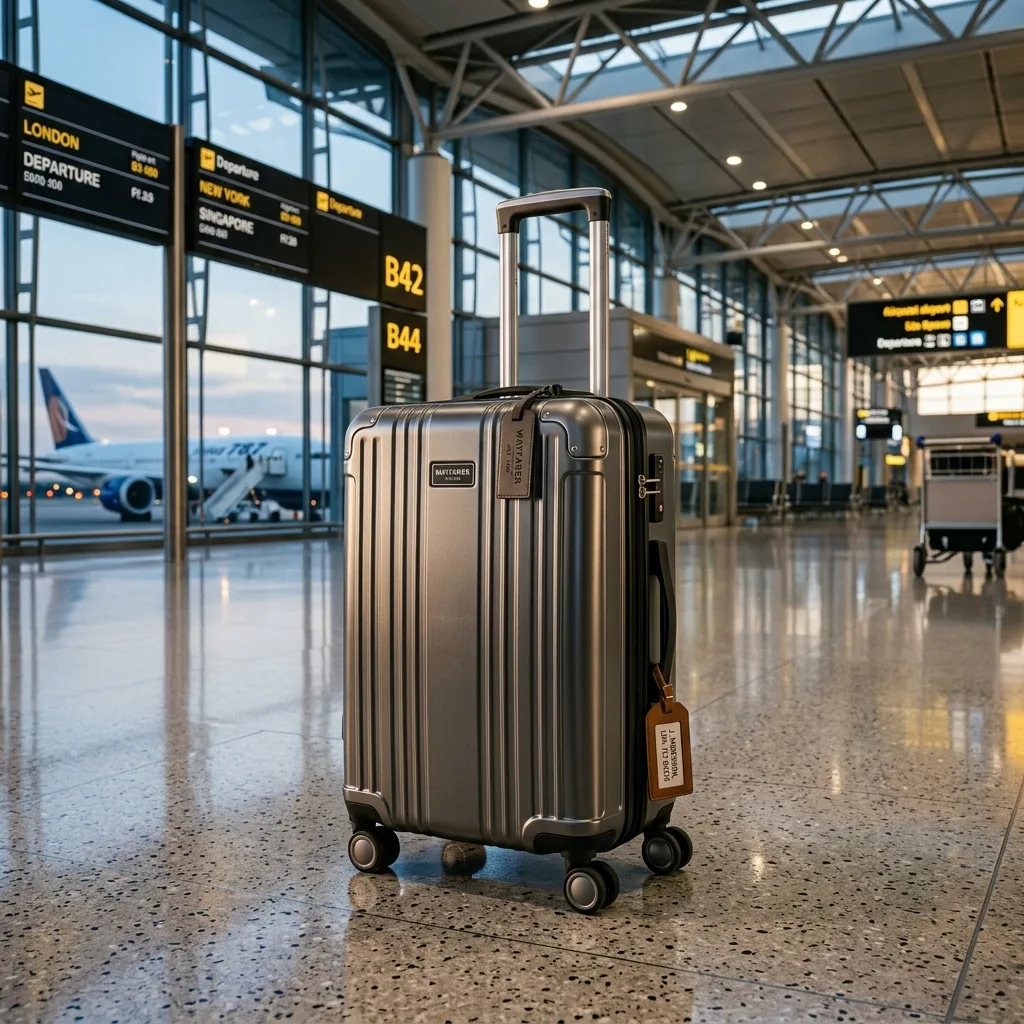
Hard-shell versus soft-shell is genuinely a matter of taste. Stiftung Warentest found minimal quality differences between the two formats. Soft-shell suitcases tend to offer useful external pockets. Hard-shell models usually come in lighter. Pick based on how you actually use the bag.
One thing most buyers overlook: actual dimensions versus listed dimensions. Several models in the test measured slightly larger than the manufacturer’s published specs. That gap matters when you’re trying to meet a specific airline’s carry-on policy. Measure your bag before you fly, and check the rules for each carrier you’re traveling with. Budget airlines — particularly in Europe and Southeast Asia — often enforce tighter limits than the industry “standard.” Some weigh carry-ons at the gate too, not just check dimensions. Know your numbers.
Packing Cubes: The Space-Saving Tool Most People Use Wrong
Packing cubes are everywhere right now. But there’s a distinction that most buyers miss, and it determines whether you actually save space or just organize the same volume more neatly.
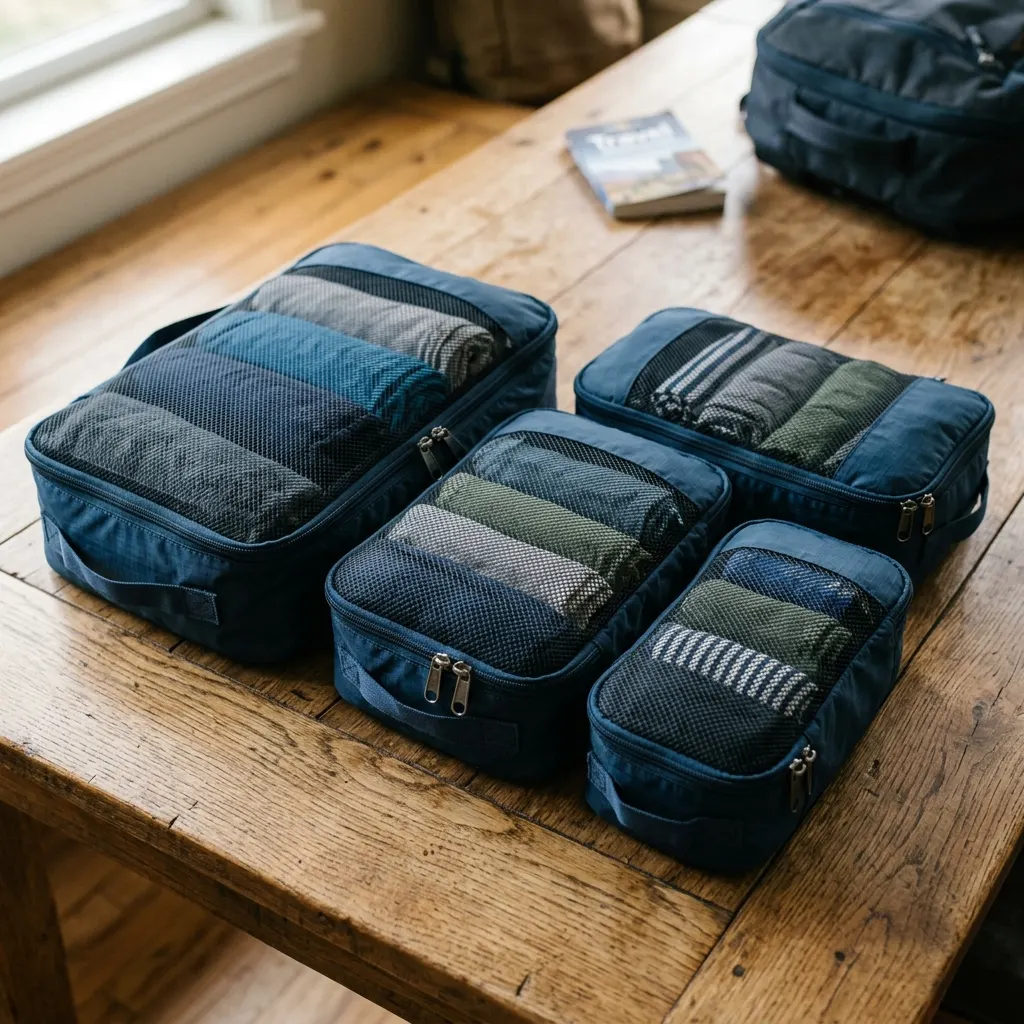
Standard packing cubes sort your clothes. Compression packing cubes reduce the volume of your clothes by forcing air out as you zip them shut. If you want to fit more into a carry-on, you need compression cubes specifically — not just any pouch with “travel” in the name. Regular organizing cubes won’t make your bag smaller. They’ll just make it tidier.
The Best Packing Cubes Compared
- ECOHUB packing cubes — The top pick for lightweight packers. Made from recycled PET bottles, fitted with YKK zippers that glide rather than snag, and light enough that the cubes themselves barely register against your carry-on weight allowance.
- Travel Dude packing cubes — The most durable option here, with effective compression and a built-in waterproof wet pocket for damp clothes or wet swimwear. Practical for beach trips or anywhere the weather is unpredictable.
- Peak Design Packing Cubes — The choice for frequent flyers who want premium materials and faster access. Double-sided compression means you can reach your clothes from either end, and the build is designed to last years of heavy use.
One practical tip that makes a real difference: roll your clothes instead of folding them before packing. It reduces creasing and lets you fit more into each cube before you compress. Rolling plus compression together is how experienced packers fit a week’s worth of clothes into a 40-liter carry-on.
Charging Gear That Works Across 200+ Countries
Running out of battery in an unfamiliar city is manageable. Arriving at your hotel with a charger that doesn’t fit the outlet is a different kind of frustrating. Modern GaN (Gallium Nitride) chargers solve the second problem well: they deliver higher power output than older charger technology in a noticeably smaller body, which matters when every gram in a carry-on counts.
Universal Travel Adapters Worth Trusting
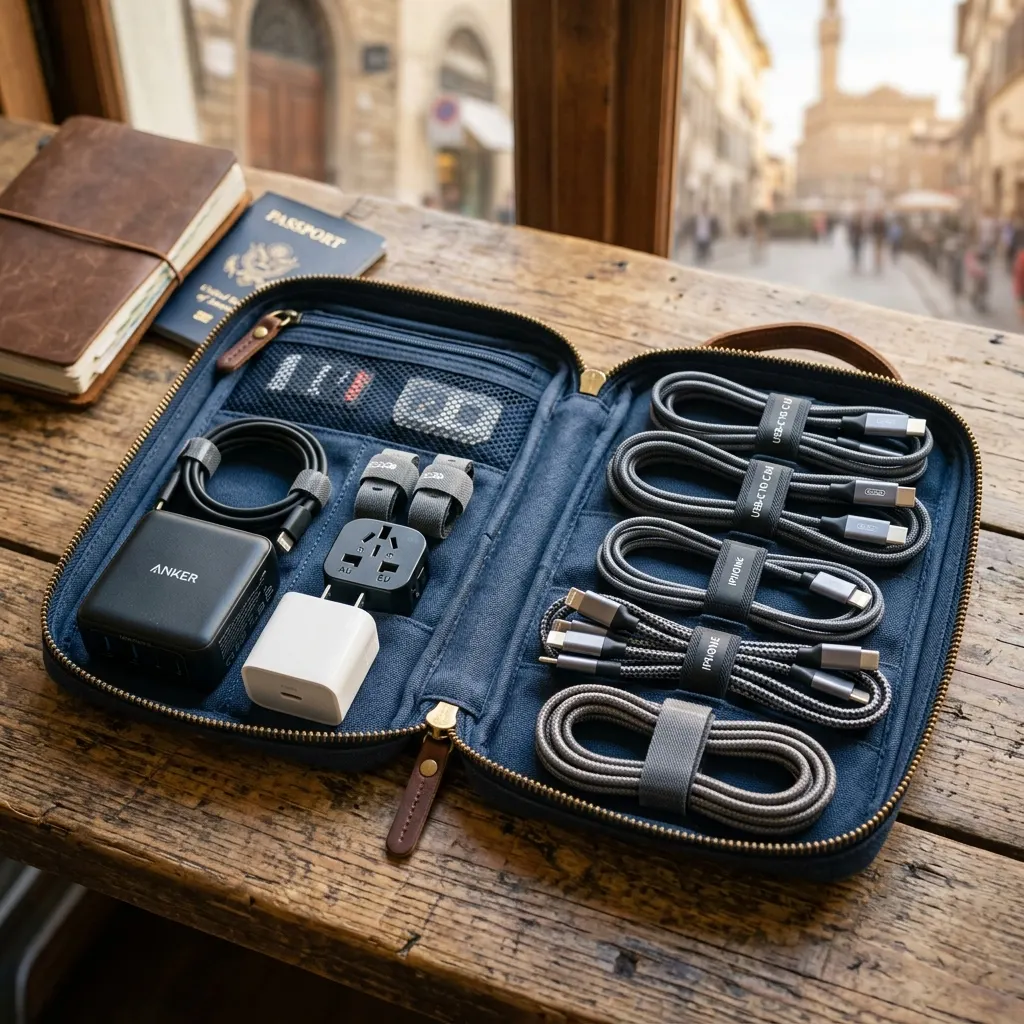
A good travel adapter in 2026 should do more than reshape the plug. The Epicka TA-105 Pro / Max and the TESSAN GM-636 both cover over 200 countries and come with multiple USB-C and USB-A ports built in. Your phone, laptop, and camera can all charge from one device — no separate chargers needed.
Here’s the thing most adapter buyers don’t realize until it’s too late: a travel adapter changes the plug shape. It does not convert voltage.
If you’re traveling to the US, Canada, or parts of South America, the standard voltage is 110V — lower than the 220–240V used across most of Europe, Australia, and Asia. Your device needs to handle the local voltage on its own. Most modern smartphones, tablets, and laptop chargers do — look for “100–240V” printed on the charger brick. Older hair dryers, electric shavers, or specialized appliances may not. Plugging a 220V-only device into 110V power won’t destroy it, but it won’t work properly. The reverse — plugging a 110V-only device into 220V without a voltage converter — can damage it. That distinction is worth understanding before you pack.
Portable Chargers and Cable Management
For power on the move, the Anker MagGo 10K and INIU SnapGo Air are both compact enough for a jacket pocket and strong enough to fully recharge most smartphones more than once. Worth noting: most airlines allow power banks in carry-on luggage only, not in checked bags. Stow them before you reach the gate.
Cable clutter is a small thing that becomes genuinely irritating by day two of any trip. A cable organizer — FYY and Moment both make reliable options — keeps everything untangled. Pair it with a multi-tip charging cable and you can cover USB-C, Lightning, and Micro-USB from a single cord.
Noise-Cancelling and Comfort Gear for Long-Haul Flights
A long-haul flight runs anywhere from 8 to 17 hours. The engine produces a constant low-frequency hum — the kind of sound active noise cancellation (ANC) was specifically built to handle. The right headphones can genuinely change the experience of arriving at your destination.
The Best Noise-Cancelling Headphones for Travel in 2026
Three models stand out this year:
- Sony WH-1000XM6 — The current all-rounder. Best-in-class ANC performance, a foldable design that fits into a reasonable carry case, and battery life that covers most long-haul routes. RTINGS ranks it at the top of the over-ear category for 2026.
- Sennheiser MOMENTUM 4 — The endurance pick. Up to 60 hours of battery life means it lasts not just the flight but the full trip without needing a recharge. The right choice if you’re wearing headphones for extended periods every day.
- Bose QuietComfort Ultra — Consistently rated the most comfortable over-ear headphone for long wear. If your main concern is how the headphones feel after hour six, Bose has the edge.
The honest trade-off: all three are over-ear headphones, which means they take up real space in your bag. If you’re packing tight, that’s a factor worth weighing before you commit.
Earbuds and Sleep Comfort for Lighter Packers
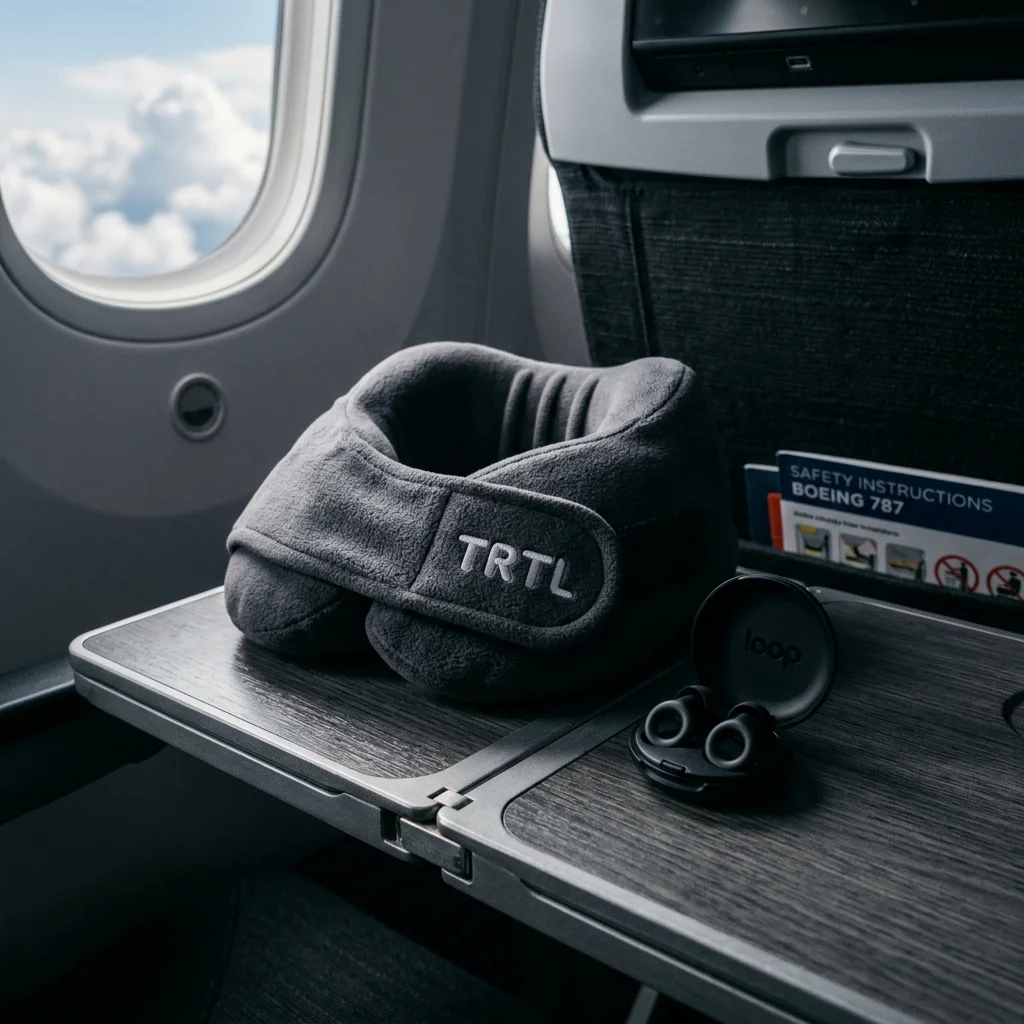
If you’d rather not carry full-size headphones, the Loop Switch 2 earbuds offer strong passive noise reduction — no battery required. They operate in different modes depending on whether you want to block sound entirely or simply reduce it to a manageable level.
Pair them with the TRTL travel pillow, which supports the neck at an angle that genuinely keeps your head from dropping forward, and you have a sleep setup that adds almost nothing to your bag weight. In practice, the TRTL works noticeably better than a standard U-shaped neck pillow — the weight distribution is different, and that difference is what lets you actually fall asleep rather than just rest your eyes.
Security Gadgets That Solve Real Problems
Not every travel security product earns its bag space. These three do:
- Apple AirTags — Luggage tracking has gone from a nice-to-have to something most frequent travelers consider non-negotiable. An AirTag in your checked bag or carry-on gives you real-time location data via Apple’s Find My app on your iPhone. One practical note: some airlines have updated their checked luggage policies around tracking devices — confirm with your specific carrier before you fly.
- Twelve South AirFly — A Bluetooth transmitter that lets you connect your wireless headphones to the in-flight entertainment system’s 3.5mm headphone jack. Small, light, and genuinely useful on airlines that haven’t updated to wireless audio output.
- USB data blocker — Public USB charging ports at airports and train stations can be set up to steal data from connected devices, a practice known as juice jacking. A data blocker allows power to pass through while blocking all data transfer. It costs a few dollars and takes a second to plug in.
What to Check Before You Buy Any of This Gear
A few things worth knowing before you spend:
The Stiftung Warentest study flagged water resistance as a weak point in several carry-on models — some let water in during rain testing despite otherwise solid build quality. If you travel through wet climates regularly, check specifically for weather resistance before buying, not just structural ratings.
Carry-on size rules are not universal. Most airlines publish a maximum, but budget carriers — especially in Europe and Southeast Asia — often enforce stricter limits. Pull up your airline’s exact policy before you fly. Arriving at the gate with an oversized bag is an avoidable and expensive problem.
And on the adapter question: the voltage issue catches people every time. The Epicka and TESSAN adapters will work in over 200 countries — but they change the plug shape, not the power. Your device handles the voltage on its own. Modern chargers for phones and laptops almost always support dual voltage. Older or specialized appliances often don’t. Check the label before you plug in.
The Gear That Makes the Biggest Difference
You don’t need all of this at once. If you’re building out your travel kit from scratch, start with a carry-on suitcase that passed an independent test — specifically the Titan Upgrade S20 — and a set of compression packing cubes. Those two changes alone shift how you travel more than almost anything else.
From there, a multi-port GaN adapter like the Epicka TA-105 Pro / Max or TESSAN GM-636 handles the international charging problem in one compact device. Add noise-cancelling headphones if you fly long-haul regularly. The Sony WH-1000XM6 is the current benchmark, but the Sennheiser MOMENTUM 4’s 60-hour battery is a real advantage for trips that run weeks rather than days.
The security tools — an AirTag, a data blocker, the Twelve South AirFly — are inexpensive enough that there’s little reason not to carry them. Good gear doesn’t guarantee a smooth trip. But it removes the friction that turns small problems into genuinely miserable ones, and that’s worth paying for.
Sources
- Spiegel Online (Stiftung Warentest carry-on luggage test, June 2026)
- Markenkoffer.de (Titan Upgrade S20 test winner details)
- Cleankids.de (Carry-on luggage test report, 06/2026)
- The Gadgeteer (Travel adapter and packing cube reviews 2026)
- Finding the Universe (Epicka adapter and travel gear guides)
- Anker Official Website (Anker Nano and MagGo specifications)
- RTINGS (Sony WH-1000XM6 ANC testing)
- What Hi-Fi? (Bose QuietComfort Ultra vs Sennheiser MOMENTUM 4)
- Bild.de (Packing cube and luggage organizer comparison test)
Quick Comparison
| Suitcase | Classification | Key Strength | Test Performance |
|---|---|---|---|
| Titan Upgrade S20 | Overall Winner | Packing layout and build quality | Scored 1.8 (lower is better) |
| Rimowa Essential Cabin S | Premium Option | Long-term durability | Stood out for long-term durability over years of use |
| Samsonite Essens 55 | Solid Mid-Range Choice | Strong protection for contents | No significant weak points in testing |
Frequently Asked Questions
Which carry-on suitcase won the 2026 Stiftung Warentest carry-on test?
The Titan Upgrade S20 was the overall winner of the test, scoring 1.8 on the German grading scale. Testers highlighted its superior packing layout and build quality compared to the other 16 models.
What is the difference between standard and compression packing cubes?
Standard packing cubes only help sort and organize your clothes. Compression packing cubes actually reduce the volume of your clothing by forcing air out as they are zipped shut, helping you save physical space in your bag.
Can travel adapters convert electrical voltage?
No, travel adapters only change the shape of the plug so it fits into local outlets, but they do not convert voltage. You must ensure your device is dual-voltage (supporting 100–240V) before plugging it into outlets with different voltage levels.
Which noise-cancelling headphones are best for travel in 2026?
The Sony WH-1000XM6 is the top-rated all-rounder for travel, featuring best-in-class active noise cancellation. If battery life is your priority, the Sennheiser MOMENTUM 4 offers up to 60 hours of play time, while the Bose QuietComfort Ultra is highlighted as the most comfortable for long flights.
Are power banks allowed in checked luggage?
No, most airlines only allow portable chargers and power banks in your carry-on luggage, not in checked bags. You should stow these devices in your cabin baggage before you reach the gate.