
How to Build a Travel Checklist That Actually Works
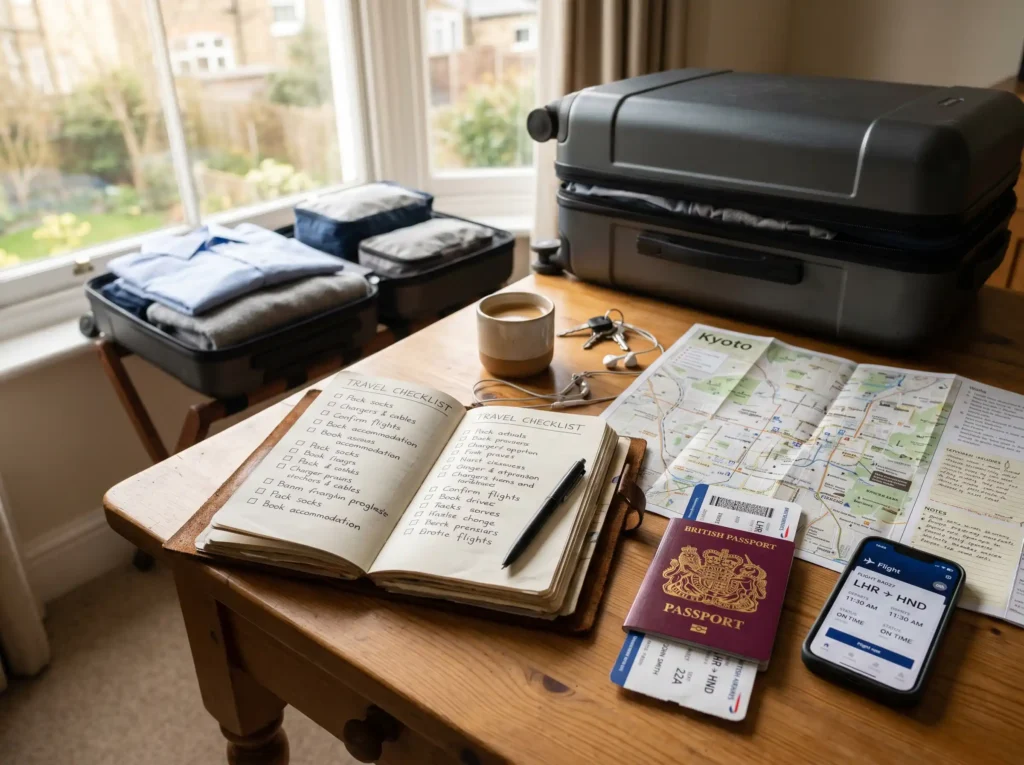
A travel checklist saves you when packing gets chaotic.
Picture this: you’re already at the airport and you realize your passport is sitting on the kitchen counter.
Most mishaps like that one are completely avoidable.
A little planning goes a long way toward making sure your trip goes the way you pictured it.
Want to see how that works in practice?
Here’s our guide to building a checklist for the trip you’ve been dreaming about.
Building Your Travel List From the Start
Putting together a list of what to pack and what needs handling before you leave is step one.
That means more than choosing outfits. You also need to track documents, your itinerary, accommodation, and your budget.
It sounds obvious, but the more you put on paper, the easier it becomes to spot what’s missing and figure out your next move.
Within minutes you’ll see everything you still need, and you can start organizing right away.
Why Your Checklist Should Grow Over Time
Here’s the part most people get wrong: a travel checklist isn’t something you write in one sitting, and definitely not during the last week before departure.
Your list takes shape throughout the entire planning process, one decision at a time.
So take it slow.
To start your checklist, think through:
- Destination: domestic or international?
- Climate: hot or cold?
- Length: a week? A month?
- Transportation: driving? Flying? Bus?
Once you can answer all of that, you’re ready for the next step.
Essential Documents and Health Items for Every Trip
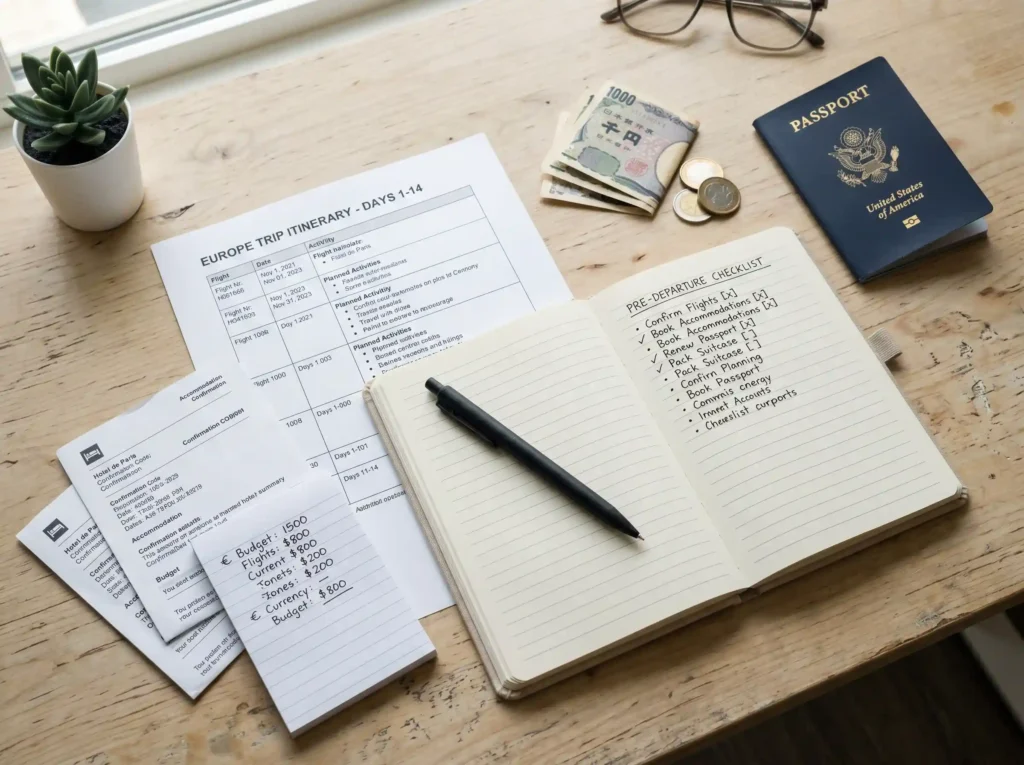
Start this part of your list well in advance, especially for international travel.
Here are the essentials:
- Documents: Scan everything and back it up to the cloud. Print copies too, and carry them in a folder.
- Vaccinations: Many countries require proof of yellow fever vaccination.
- Medication: pain relievers, bandages, anti-nausea and headache medicine, muscle relaxants, allergy medication, sunscreen, and anything else that gives you peace of mind on the road.
- Medical checkup: the better shape you’re in, the lower your odds of getting sick away from home.
- Packing list: clothing, shoes, accessories, cameras, toiletries, and any extra gear you need.
- Unlocked credit cards: a must for international trips.
- Travel insurance: beyond covering accidents, it’s mandatory in some destinations — Europe among them.
Packing for Long Trips: A Smarter Approach
For longer trips, you don’t need to stuff your suitcase with an outfit for every single day.
The smarter move is picking neutral pieces that work for about a week.
That way you can mix and match as the days go by, and send things to the dry cleaner when you actually need to.
If your trip runs even longer, it’s worth setting up power of attorney so someone you trust can handle important matters on your behalf.
Your Travel Clothing List
The more minimalist your packing, the lighter and more practical your trip becomes.
A few items belong in your suitcase no matter the climate:
- Underwear
- Pants (two pairs, maximum)
- Tops (five, on average)
- Shorts and skirts (one of each)
- Dresses (one casual, one for a night out)
- Rain jacket
- Windbreaker
Beyond that, prioritize clothing that’s comfortable, resists wrinkles, and washes easily.
Packing for Cold or Warm Weather
Add clothing suited to the climate you’re heading into.
If it’s cold:
- Hat, scarf, gloves
- Boots
- Coat
- Base layer
Choose the right thermal layers and you’ll free up real space in your suitcase. One good base layer beats packing three sweaters.
If it’s warm:
- Beach cover-up
- Light dresses, shorts, and skirts
- Tank tops
- Swimwear
Checked Bag vs. Carry-On: What Goes Where
For a smooth trip, split your packing across at least two bags.
Checked baggage: clothing, shoes, accessories, and any heavier gear.
Carry-on: important documents, your wallet, phone, charger, electronics, a small kit of useful medication, toiletries, sunglasses, a book, a spare change of clothes, and a jacket.
How to Pack Your Suitcase So Everything Fits
Packing organizers make a real difference — think underwear pouches and separate bags for medication and toiletries.
Another trick: keep your shoes on the sides of the suitcase. They take up less room that way.
Heavier items, like pants and jackets, always go at the bottom of the bag.
A luggage tag matters too. It keeps your bag from getting mixed up with someone else’s, or lost for good.
Planning an International Trip
International trips tend to run longer, demand more paperwork, and need more careful planning as a result.
So here’s what to keep in mind.
Mapping Out Your Itinerary
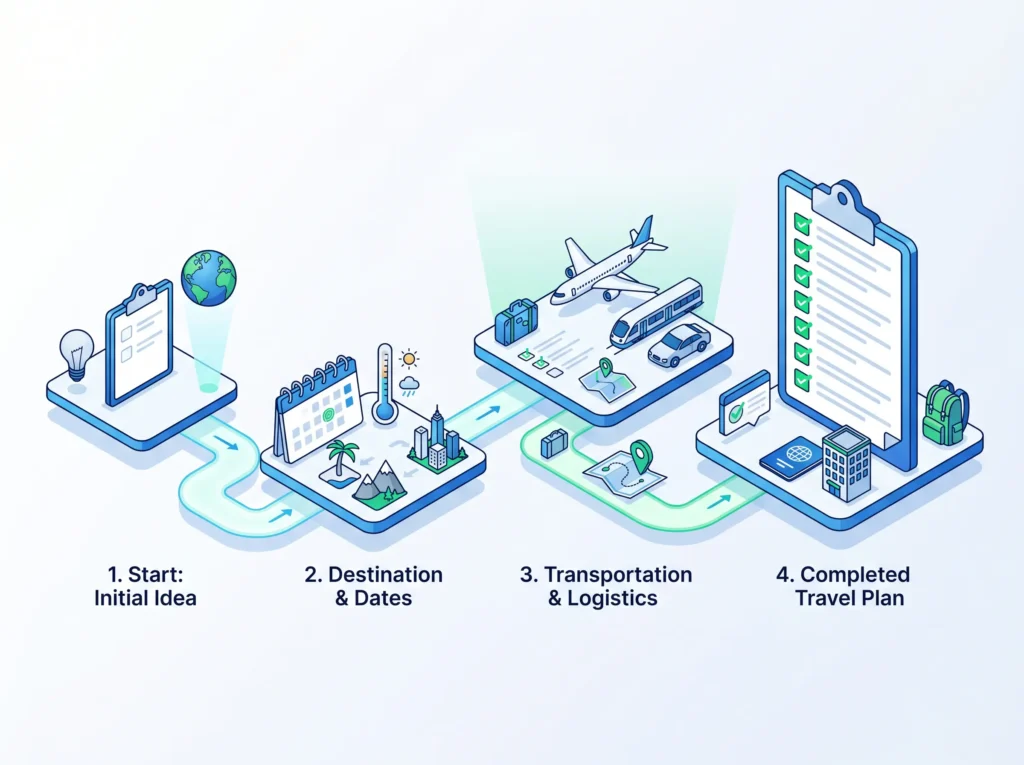
Putting together your itinerary is the most enjoyable part of planning.
And the earlier you nail it down, the more time and money you’ll save from the start.
What to Research Before You Go
Once you’ve decided where you’re headed, it’s time to plan your days.
Our advice: research, research, and then research some more. That’s exactly what the internet is for.
Try to map out:
- Main attractions
- Best restaurants
- Local transportation
- Budget for tours
- Time needed at each attraction
A few Google tools that make itinerary planning easier: Google Maps, Street View, and Google Translate.
Booking Your Accommodation the Smart Way
When it comes to locking in your hotel, technology is your best friend — lean on tools like Booking.com and TripAdvisor.
Almost all of them ask for a credit card number to confirm the reservation, even though the charge usually only goes through at check-in.
Important: don’t forget to print your booking confirmation.
International Travel Document Checklist
International trips involve a bit more red tape, but nothing too complicated.
Passport, visa, travel insurance, and an international vaccination card are among the documents immigration officers may ask to see.
Here’s what to check before heading to the United States or Europe.
Travel Checklist for the United States
- Valid passport (valid for at least 6 months after your travel date)
- Visa (staple it to your passport so you don’t lose it)
- Plane tickets, including your return flight
- Driver’s license
- Car rental voucher and hotel reservation
- Printed tickets for tours and attractions
- Cash and unlocked credit cards (buying dollars ahead of time can help you avoid exchange rate swings)
- Travel insurance: not required, but strongly recommended
- Proof of funds (evidence that you have enough money to cover your stay)
- Travel guidebook
- Tour guide and Google Translate (picking up some basic English helps too)
- Power adapters
- International phone SIM card
- List of emergency contacts
- Maps (download them so you can check them offline)
- Pens, for immigration forms
Travel Checklist for Europe
The requirements here are largely the same as above.
That said, travel insurance is mandatory in 25 European countries — in other words, across nearly the entire continent.
Most European countries don’t require an International Certificate of Vaccination against yellow fever, but there are exceptions.
When in doubt, check Anvisa’s website, under the “Travel Requirements” tab.
Travel Checklist for South America and Brazil
A checklist for domestic travel or trips to neighboring countries is simpler, but no less important.
- National ID: valid for travel within Brazil and 9 other South American countries
- Passport: when in doubt, always carry a valid passport
- Vaccination certificate: required in Acre, Amazonas, Amapá, the Federal District, Goiás, Maranhão, Mato Grosso do Sul, Pará, Rondônia, Roraima, and Tocantins
Pack Light, Travel Smart
No trip comes together without a plan.
A travel checklist is the simplest way to make sure you don’t leave anything behind.
One last thing: never pack more than you can comfortably carry. Less really is more.
Frequently Asked Questions
How far in advance should I start building my travel checklist?
Your travel checklist shouldn’t be written in a single sitting or left until the final week before departure. Instead, it should grow dynamically across your entire planning cycle, letting you log required gear, updates, and bookings one step at a time.
What items should always go into a carry-on bag?
Your carry-on bag should hold all essential documents, your wallet, phone, chargers, and core electronics. It is also highly recommended to pack a small medical kit, travel-sized toiletries, sunglasses, a book, a light jacket, and a spare change of clothes in case your checked baggage goes missing.
Is travel insurance mandatory for trips to Europe?
Yes, travel insurance is strictly mandatory across 25 European countries. While destinations like the United States strongly recommend coverage rather than enforcing it as a legal mandate, having travel medical protection ensures you avoid costly out-of-pocket bills during unforeseen medical incidents.
Can I travel within South America using just a national ID card?
Yes, a national ID card is completely valid for cross-border travel within Brazil and nine other neighboring South American nations. However, if you are uncertain about regional border rules or connecting transit guidelines, carrying a valid passport remains the safest fallback choice.
How can I pack a suitcase more efficiently for long trips?
The most effective strategy for packing long-haul is to select neutral clothing items that can easily match and rotate for roughly a week. Additionally, lean on dedicated packing organizers, keep footwear lined tightly along the bag walls, and layer heavy items like boots and trousers at the bottom of the suitcase.
